MUSE’s Strategic Plan
The development of MUSE’s Strategic Plan 2026–2028 reflects a conscious commitment to accountability and public visibility: the Plan is not a mere formality, but a tool for vision and transparency capable of articulating the museum’s identity, priorities and development trajectories for the next three years against the backdrop of the profound environmental, social, cultural and technological transformations currently underway. The Plan builds on MUSE’s established culture of accountability, already reflected in its Mission Statement, by introducing a further level of strategic planning and providing a more systematic framework for the planning and evaluation of activities.
The participatory process
MUSE’s Strategic Plan is the result of a participatory and iterative process, methodologically grounded in the integration of documentary analysis, contextual analysis, field research, co-creation and external consultation. This process has enabled the development of a document rooted in the museum’s practical operating conditions and looking towards a new future horizon. The Plan has been conceived as a ‘living’ tool, open to revision and designed to support continuous cycles of organisational learning.
The strategic framework
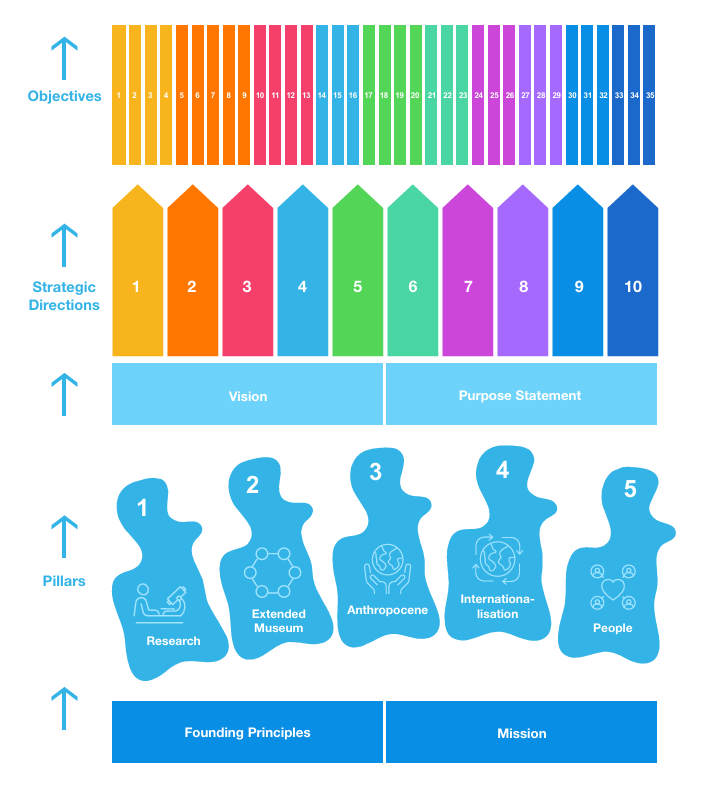
The strategic structure of the document is built progressively: starting with the statement of MUSE’s founding principles and mission, the Plan identifies five pillars — Research, the Extended Museum, the Anthropocene, Internationalisation, and People — to which is added a cross-cutting commitment to sustainability and planetary wellbeing. On this basis, through the conduct of a strategic analysis, the museum’s vision is outlined, complemented by the statement of purpose. This process leads to the identification of 10 strategic guiding lines, which in turn are translated into 35 strategic objectives spread over the three-year period. This structure makes the interconnection between values, strategic choices and operational planning clear.
Mission, vision and statement of purpose
The Strategic Plan reaffirms MUSE’s identity as a public institution that combines scientific research – with a particular focus on mountain environments – with strong local roots, innovative public engagement activities and an openness to contemporary debate. Building on this premise, the museum aims to work towards strengthening the dialogue between the sciences and the humanities by initiating, guiding and supporting actions aimed at the care of every individual and eco-social education, with a view to the systemic dimension of planetary wellbeing.
Strategic priorities for the three-year period
The Plan aims to establish MUSE as a qualified and recognisable laboratory focused on reinterpreting the relationship between humanity and nature in the context of the Anthropocene, with particular attention to the mountain environment. This is complemented by a number of strategic priorities: strengthening research and its pervasive role across the museum’s various functions; renewing themes, languages and tools to enhance cultural impact and appeal; consolidating regional, national and international networks and bolstering the museum’s authority; enhancing regional branches and forging links with local communities; strengthening communication with new audiences; the development of a data-driven approach to management; and investment in equity, inclusion, accessibility, internal participation and quality of work. The Plan therefore aims to pursue a vision of a museum that combines scientific authority, cultural innovation, civic responsibility and organisational well-being.
A transformation unfolding over time
The three-year strategic roadmap allows us to view this change as a progressive journey. 2026 marks the start of MUSE’s key projects, both tangible and intangible: the launch of the reorganisation of the permanent exhibitions, the experimentation with new forms of expression and accessibility standards, the strengthening of biodiversity research, the introduction of new planning tools and the establishment of a more sophisticated approach to data; 2027 represents the year of transformation and the integration of new strategic initiatives; 2028 coincides with consolidation, that is, with the full visibility of the results, their systematisation and the preparation for the next cycle.
Implementation, monitoring and accountability
The document assigns a central role to the implementation of the provisions set out in the Plan. The strategy is, in fact, accompanied by indicators, periodic reviews, interim assessments and monitoring tools designed to make the progress of actions observable and the results measurable. MUSE’s activities are therefore understood as the process of implementing the strategy, spanning the period between planning and reporting. In this way, the 2026–2028 Strategic Plan is not a static document, but an ongoing organisational practice, focused on impact, transparency and accountability to the community.
An overall vision
Taken together, the pillars, mission, guiding principles, vision and objectives aim to provide the framework for our museum’s commitment in the coming years. A commitment geared towards generating knowledge, fostering participation and promoting processes of change towards a better Anthropocene. It is therefore a visionary and operational plan, but first and foremost a manifesto of the care with which we intend to continue the journey of the forward-looking public investment that has taken shape in MUSE.